All-sky Release - PSC - Photometric Precision
The Level 1 Specifications call for the 1-sigma photometric precision of unconfused point sources with SNR>>20 to be better than 5% in all three bands.
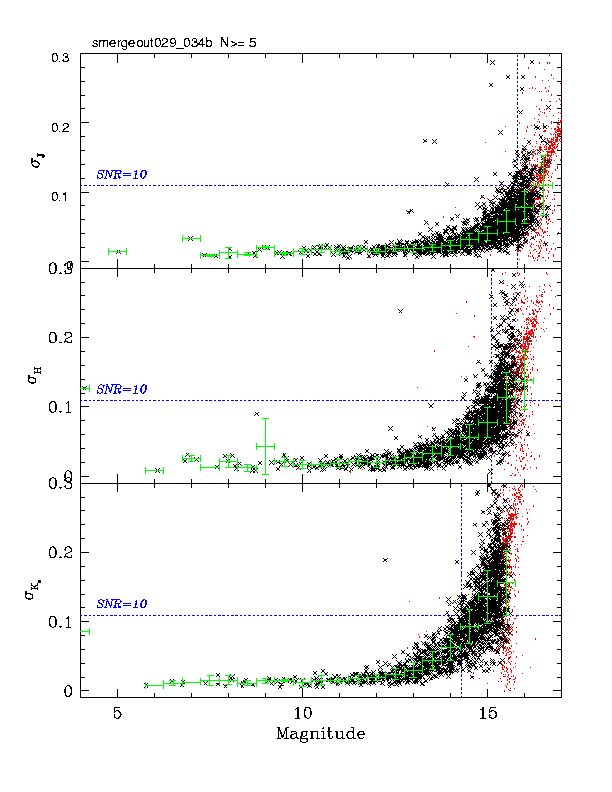 During each hour of survey operations, one of the 2MASS 1° x 8.5´
calibration star regions was scanned six consecutive times to monitor the
transparency of the sky. The
RMS deviation in the six individual photometric measures for each star also
provides a continuous monitor of the photometric precision. Shown at right
is the plot for a six-time repeat of a
calibration star region illustrating the RMS repeatability of each star's
photometry (black x's) as a function of magnitude. The photometric precision
is the part of the curve where the repeatability is roughly constant with
magnitude. This asymptote is the ultimate limit of our measurement accuracy,
which is dominated by pixelization effects.
During each hour of survey operations, one of the 2MASS 1° x 8.5´
calibration star regions was scanned six consecutive times to monitor the
transparency of the sky. The
RMS deviation in the six individual photometric measures for each star also
provides a continuous monitor of the photometric precision. Shown at right
is the plot for a six-time repeat of a
calibration star region illustrating the RMS repeatability of each star's
photometry (black x's) as a function of magnitude. The photometric precision
is the part of the curve where the repeatability is roughly constant with
magnitude. This asymptote is the ultimate limit of our measurement accuracy,
which is dominated by pixelization effects.
A comparison of the RMS repeatability of these data to the photometric errors calculated by the 2MASS profile-fitting routines (which applies to rd_flg='2' sources) has been made. This comparison showed that errors from the profile-fitting were overestimated by about a factor of two for sources brighter than J=14.0, H=13.0, and Ks=12.5 and by a smaller factor for fainter objects. The problem arose from a spurious, systematic component of the PSF-variance estimate, as explained in more detail elsewhere. A semi-empirical approach was used to correct these calculated errors. By subdividing the calibration scan data into bins sorted by magnitude and by PSF families, a suite of corrections was amassed. Those corrections were applied to the profile-fit photometric errors for rd_flg='2' stars in the science scans; photometric errors for rd_flg='1' sources were unaffected since these are derived from aperture measures and already represent the true statistical uncertainty of the six individual aperture measurements. These corrected errors are denoted by [jhk]_cmsig in the Point Source Catalog. (Other sources of error - including flat fielding error, the uncertainty of the absolute calibration, PSF shape mismatches due to seeing and focal plane distortion, and PSF/aperture normalization - are represented in the "combined" photometric uncertainties, given as [jhk]_cmsigcom in the Point Source Catalog.)
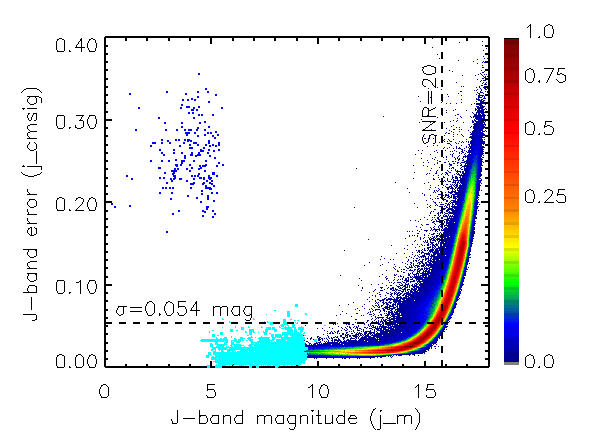
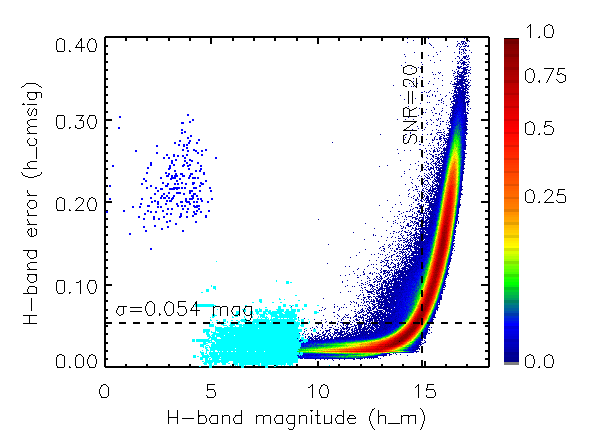
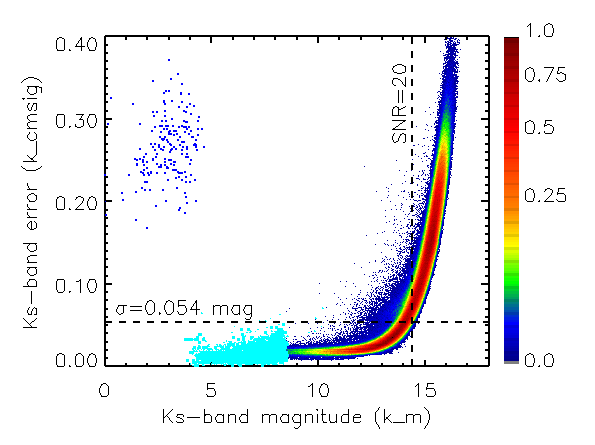
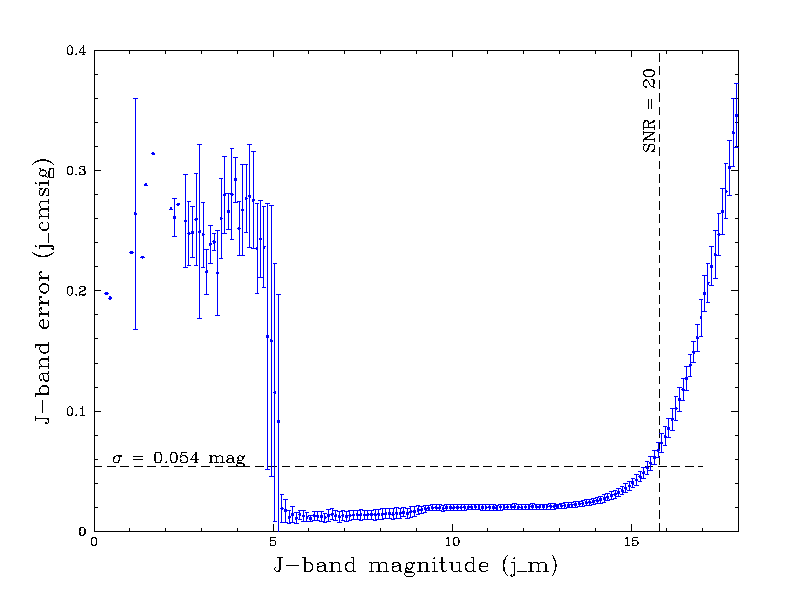
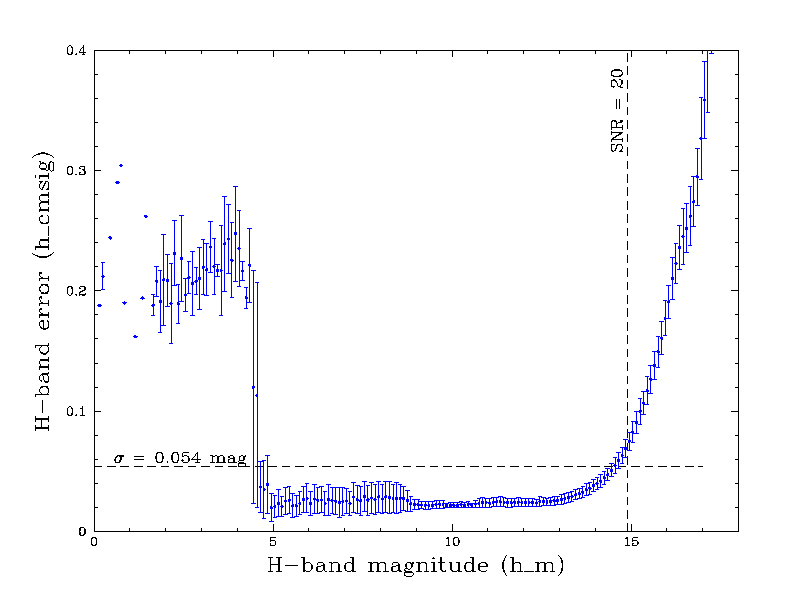
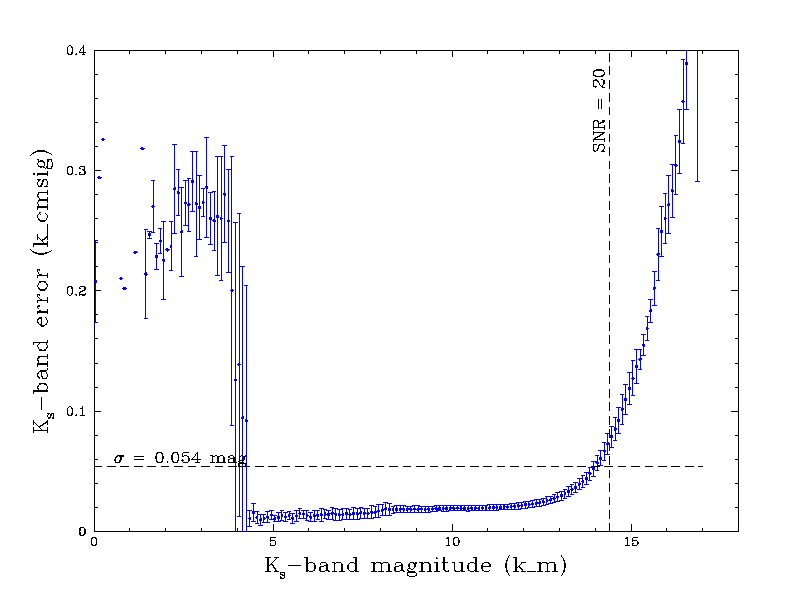
The plots below show [jhk]_cmsig as a function of magnitude for a representative region of the Point Source Catalog. The 1.9 million points plotted are unconfused point sources lying within 15° of the North and South Galactic Poles. In the top row, photometry (via profile fits) of unsaturated rd_flg='2' stars is shown by a multi-color density plot, and photometry (via aperture measures) of unsaturated rd_flg='1' stars is shown by light blue dots. (Extremely bright stars - known as rd_flg='3' sources and saturated even in the short Read1 exposures - are shown by the dark blue points in the upper left. Although of much lower precision, these "bonus" observations are provided for completeness and are not subject to the level-1 specifications.) In the bottom row of plots, blue dots show the trimmed averages of the resulting [jhk]_cmsig values at each 0.1-mag bin. The plots demonstrate that for rd_flg='1' and rd_flg='2' stars with SNR levels much higher than 20, the photometric precision meets the 5% (0.054 mag) requirement.
 |
 |
 |
 |
 |
 |
| J | H | Ks |
These plots demonstrate that the 2MASS all-sky release dataset meets the Survey requirements for photometric precision.